Suede Trench Coats for Women
The suede trench coat takes one of the most enduring silhouettes in outerwear - the long, clean line that falls below the knee, the straight body, the structured shoulder - and renders it in a material that gabardine cannot match for warmth, depth, or texture.
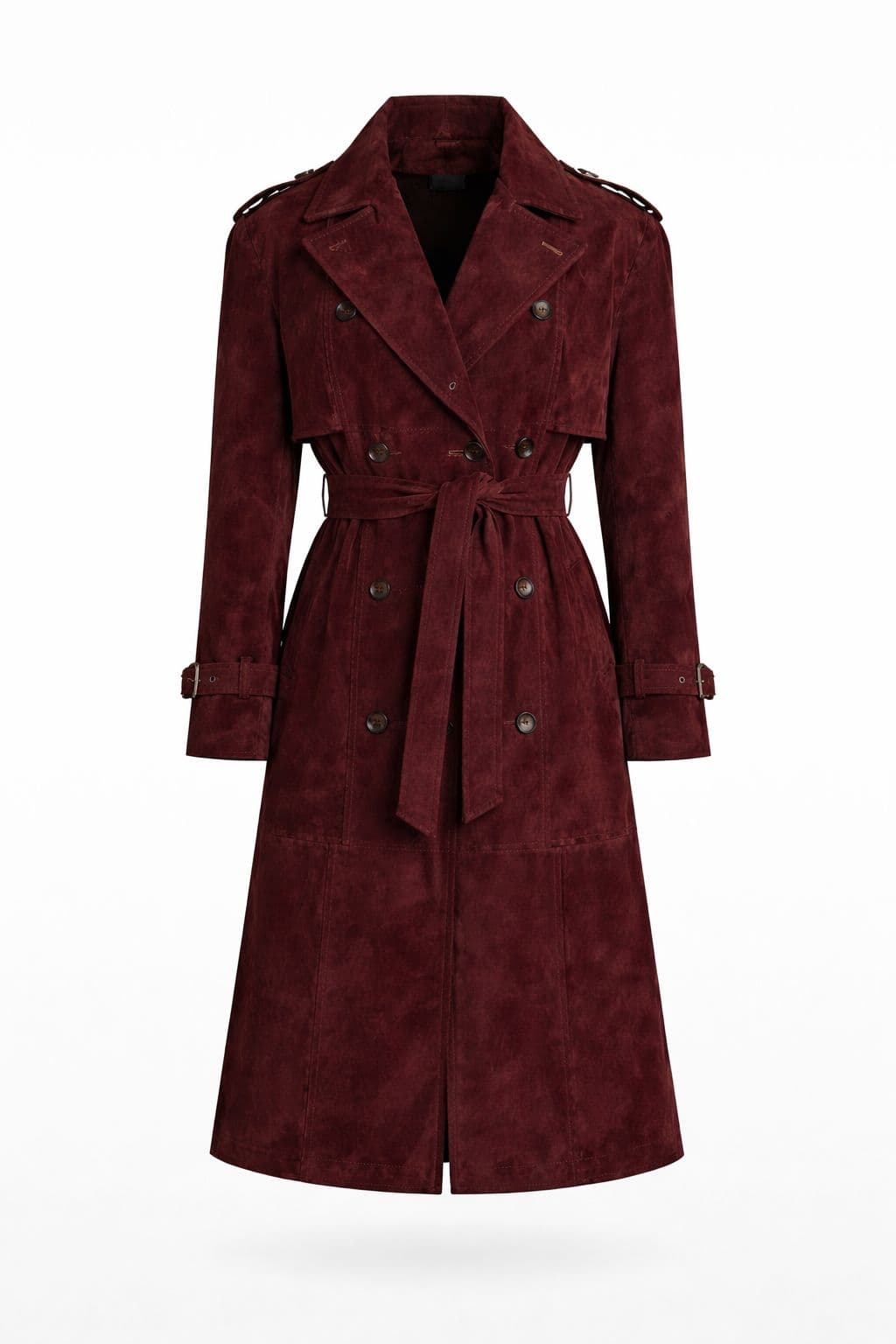
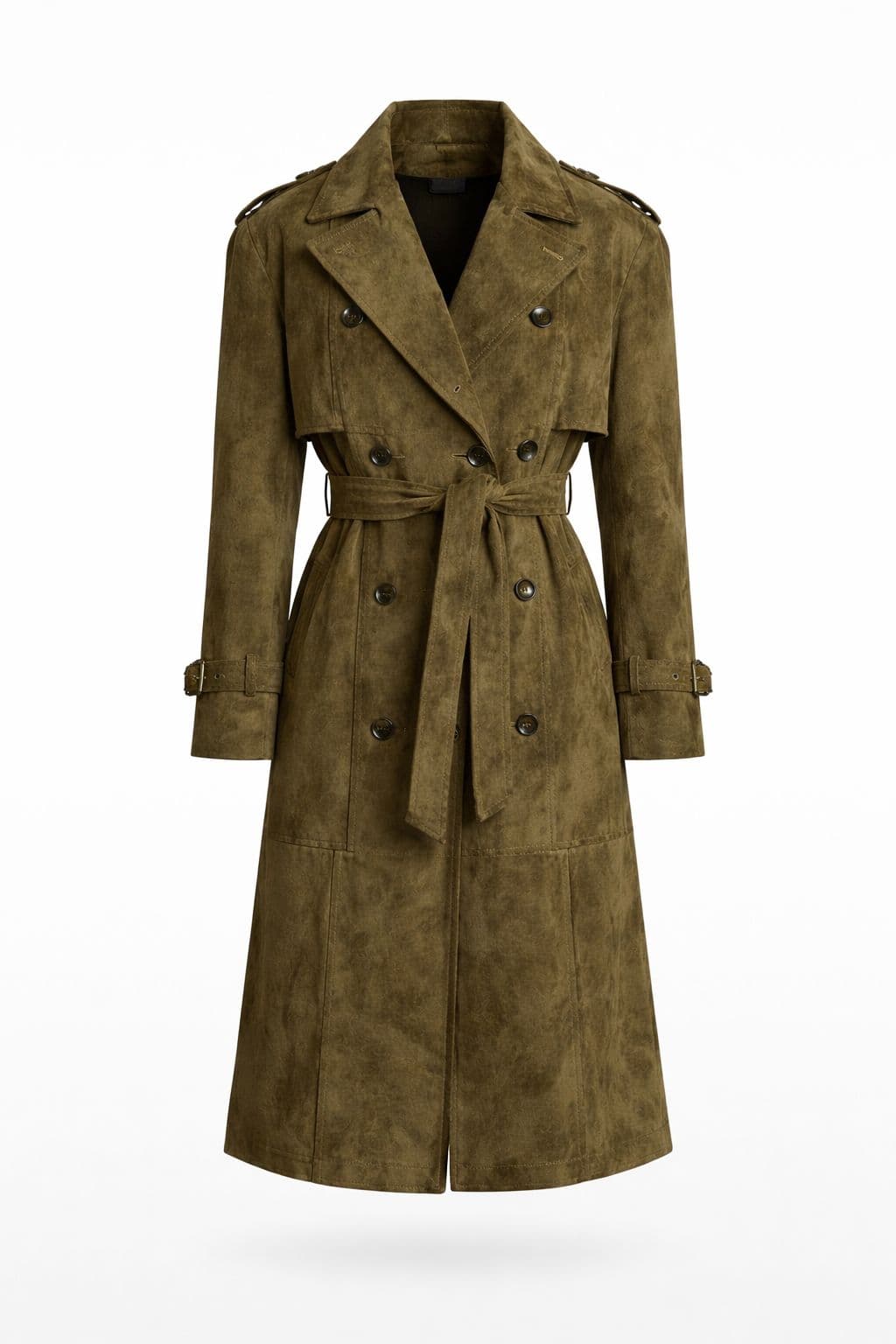
This guide covers what separates a genuine suede trench from a suedette mac, which length suits which frame, how the fit should sit, and what to check before you buy. Below it you will find the Clémence, our own longline suede coat built on trench proportions, in Bordeaux and Olive.
Discover the Collection
What Makes a Suede Trench Coat Different
A trench coat is defined by proportion before it is defined by fabric. The silhouette that emerged from military outerwear and became a wardrobe constant has three consistent traits: a length that falls below the hip and usually below the knee, a straight or gently A-line body that skims rather than clings, and a structured shoulder that holds its line without padding.
Render that silhouette in genuine suede and the character changes completely. Gabardine is crisp, water-shedding, and impersonal. Suede is soft, light-absorbing, and responsive - it drapes closer to the body, moves with you rather than around you, and develops a patina that makes a five-year-old coat look better than a new one. You lose some weatherproofing. You gain warmth, texture, and a garment that becomes specifically yours.
That trade is the whole decision. If you need a coat that shrugs off sustained rain, buy gabardine. If you want the trench silhouette as a piece of tactile luxury you will reach for on nine days out of ten, suede is the better material by a wide margin.
The Anatomy of a Suede Trench Coat
Suede trench coats vary more than gabardine ones, because the material lets designers drop the hardware-heavy details that gabardine needs for structure. Here is what the traditional elements become when the fabric changes.
| Element | Classic gabardine trench | In genuine suede |
|---|---|---|
| Closure | Double-breasted, 10 buttons | Often single-breasted or concealed, to avoid bulk |
| Belt | Wide buckled belt, always | Optional - many suede versions drape unbelted |
| Storm flap | Structural, sheds water | Usually omitted; suede is not a rain fabric |
| Epaulettes | Standard military detail | Frequently dropped for a cleaner shoulder |
| Length | Below knee to mid-calf | Hip to mid-calf, depending on silhouette |
| Lining | Full, often removable | Full smooth lining, essential for drape |
| Weight | Light, crisp | Medium to substantial, depending on hide |
The pattern is consistent: suede trench coats keep the proportion and shed the hardware. A coat that keeps every gabardine detail in suede tends to look costumed rather than considered. Read more on how the details differ across styles in our guide to suede coat types and silhouettes.
Genuine Suede, Suedette, and Faux-Suede Macs
Search for a suede trench and you will find three quite different products sold under overlapping language. The distinction matters more here than in almost any other category, because a trench is a long garment and long garments expose the difference in drape immediately.
| Material | What it is | How it ages |
|---|---|---|
| Genuine suede | The inner split of a hide, napped to a soft finish | Develops patina, softens, lasts decades with care |
| Suedette / faux-suede mac | Polyester microfibre engineered to mimic nap | Holds its look, then pills and flattens; does not patina |
| Microsuede / Alcantara | High-grade synthetic, often upholstery-derived | Very durable, uniform, but stays visually flat |
A suedette mac has real advantages: it costs a fraction as much, it handles rain without ceremony, and it machine-washes. What it cannot do is age. Synthetic nap is uniform by design, so it never gains the depth of tone that makes a genuine suede coat look better in year five than in year one. If you want a rain-ready layer for commuting, a suedette mac is a sensible buy. If you want a coat that becomes a signature piece, it is not.
We work exclusively in genuine suede, so we are not neutral here - but the honest framing is that these are different products for different jobs. Our genuine suede versus faux suede comparison goes into the testing detail if you want to tell them apart in person.
Choosing Your Length
Length does more work than colour in determining whether a suede trench reads as elegant or as costume. The right answer depends on your height and on what you wear underneath.
| Length | Falls at | Best for |
|---|---|---|
| Cropped | Hip | Petite frames, layering over dresses |
| Longline | Mid-thigh to knee | Most versatile; works on nearly every height |
| Midi | Just below knee | Taller frames, formal and evening wear |
| Maxi | Mid-calf | Statement dressing; needs height to carry it |
Longline is the safest starting point and the closest suede equivalent to the classic trench proportion. It covers a suit or a dress, it does not swamp a shorter frame, and it works over both trousers and skirts. Our full suede coat lengths guide covers the edge cases, and best suede coats for petite women has specific proportional advice if you are under 5'4".
How a Suede Trench Coat Should Fit
Suede has almost no stretch, which makes fit less forgiving than wool and much less forgiving than a synthetic mac. Three checks decide it:
- Shoulder seam - it should sit at the edge of your shoulder, not past it. This is the one measurement a tailor cannot easily correct on a suede garment.
- Layering room - fasten the coat over the thickest thing you will realistically wear beneath it. A knit and a shirt, not a t-shirt.
- Sleeve length - to the wrist bone with your arm relaxed. Suede sleeves cannot be lengthened later, so err long rather than short.
If you are between sizes in a longline suede coat, size up. The drape depends on the coat hanging cleanly from the shoulder, and a coat pulled tight across the back loses the line entirely. Our suede coat sizing guide has the measurement chart, and how a suede coat should fit walks through the fitting-room checks in detail.
Colours That Hold Their Value
Suede takes colour with more depth than woven fabric because the nap scatters light, so every shade reads slightly differently as you move. That rewards rich, saturated tones over flat neutrals.
- Bordeaux - reads as a neutral in practice, pairs with camel, navy, grey, cream, and black. The most versatile non-obvious choice.
- Olive - warm, earthy, and unusually good with denim and other neutrals. Quietly distinctive.
- Cognac and tan - the classic suede tones, strongest in autumn palettes.
- Chocolate and espresso - the closest suede gets to a true wardrobe neutral.
- Black - elegant, but suede's texture is what makes it interesting, and black hides texture.
For a long coat specifically, we would steer away from very pale shades. A maxi or midi length puts a large area of suede close to road spray and seat backs, and pale nap shows every mark. See the full suede coat colour guide for pairing detail.
Living With a Suede Trench Coat
The single most common reason people hesitate over suede outerwear is rain, and the honest answer is that suede handles light rain far better than its reputation suggests and sustained rain far worse.
- Light drizzle is genuinely fine. Shake the coat off, hang it on a broad hanger, let it dry at room temperature away from radiators.
- Heavy or prolonged rain will darken and stiffen the nap. It is usually recoverable, but it is a job, not a shrug.
- Protect it before first wear with a suede-specific spray, then reapply a few times a season.
- Never dry suede with direct heat. That is what causes permanent stiffness.
- Store on a wide wooden or padded hanger with room on both sides. Suede needs air; a garment bag that seals is worse than no bag.
If the worst happens, what to do when a suede coat gets wet is a step-by-step recovery process, and how to waterproof a suede jacket covers protection without darkening the colour.
Styling a Longline Suede Coat
A long suede coat is a strong enough piece that it works best as the only strong piece in an outfit. Keep what is underneath simple and let the material do the work.
- Office - over tailored trousers and a fine knit, with a loafer or ankle boot. The coat reads as considered rather than casual.
- Weekend - straight or wide-leg denim, a crew-neck knit, and a clean leather sneaker or a boot.
- Evening - over a slip dress with a heeled boot. The texture contrast between suede and silk is the whole point.
- Travel - over knitwear and trousers in a single tonal family. Suede resists creasing far better than wool, which makes it an unexpectedly good travel coat.
More combinations in how to style a suede coat: 12 outfits, plus what to wear under a suede coat for layering specifics.
A Buyer's Checklist
Whatever you end up buying and wherever you buy it, these are the checks worth making before you commit:
- Confirm the material is genuine suede, not suedette or microsuede. Product copy that says only "suede-effect" or "suede-touch" is telling you it is synthetic.
- Ask which hide it is. Lambskin is softest, goatskin is most durable, calfskin sits between them.
- Check that it is fully lined. An unlined suede coat drapes poorly and wears unevenly.
- Look at the seams from the inside. Even stitching and bound edges signal a maker who expects the coat to last.
- Check the return window before ordering, because suede fit is unforgiving and you may need to exchange a size.
- Ask about care. A seller who cannot tell you how to look after the coat probably did not build it to last.
Our how to spot a quality suede coat guide goes deeper on each of these, including the hand-feel tests you can only do in person.
The Lustré Take on the Suede Trench
We should be precise about what we make, because the trench category invites vagueness. The Clémence is a longline suede coat built on trench proportions - the below-knee length, the straight body, the structured shoulder, the full smooth lining. It is not a belted double-breasted trench, and we do not describe it as one. We dropped the belt, the storm flap, and the epaulettes deliberately, because in genuine suede those details add bulk without adding function.
What you get instead is the silhouette that makes a trench worth owning, in a material that gabardine cannot match for warmth or texture, cut from 100% genuine suede with room to layer a knit underneath. It is available in Bordeaux and Olive, and it is made to be worn hard for a decade rather than replaced every second autumn.
If a belted, double-breasted trench is specifically what you are after, we would rather tell you honestly that this is not that coat than sell you the wrong thing. If what you want is the long, clean, elegant line of a trench with the depth of real suede, this is exactly it.
Explore More
Common Questions
- What is a suede trench coat?
- A suede trench coat takes the classic trench silhouette - below-knee length, straight body, structured shoulder - and renders it in genuine suede instead of gabardine. Most suede versions simplify the traditional hardware, dropping the storm flap and epaulettes, because those details add bulk in a heavier material. The result is warmer and more tactile than a classic trench, with a softer drape.
- Can you wear a suede trench coat in the rain?
- In light rain, yes. Shake it off and let it dry at room temperature away from direct heat and it will be fine. Sustained or heavy rain will darken and stiffen the nap, which is usually recoverable but takes work. Treat the coat with a suede protector spray before first wear and reapply a few times each season.
- What is the difference between a suede trench and a suedette mac?
- A suedette mac is polyester microfibre engineered to imitate suede's nap. It costs far less, handles rain without care, and often machine-washes. What it cannot do is age - synthetic nap is uniform by design, so it never develops the patina that makes genuine suede look better over time. Suedette eventually pills and flattens; genuine suede softens and deepens in tone.
- Should I size up in a suede trench coat?
- If you are between sizes, yes. Suede has almost no stretch, and a longline coat depends on hanging cleanly from the shoulder to keep its line. Fasten it over the thickest knit you will realistically wear underneath before deciding. The shoulder seam should sit at the edge of your shoulder - that is the one measurement a tailor cannot easily correct on a suede garment.
- What length should a suede trench coat be?
- Longline, falling between mid-thigh and the knee, is the most versatile and the closest suede equivalent to classic trench proportion. It covers tailoring and dresses without overwhelming a shorter frame. Midi and maxi lengths make a stronger statement but generally need height to carry them, and they put more suede in contact with road spray.
- Is a suede trench coat worth the investment?
- It depends on wear frequency. A genuine suede coat cared for properly lasts a decade or more and looks better as it ages, which makes cost per wear favourable against replacing a synthetic coat every few seasons. If you will wear it weekly through autumn and spring, the maths works comfortably. If it will come out three times a year, a suedette mac is the more rational purchase.
Handcrafted from 100% genuine suede. Free shipping on orders above $330.